The ground shuddered again as Talaan crossed the fractured plaza leading up to the Grand Archives. Fine grains of dust, shaken loose from the tremor, drifted into the dim morning light. She paused, watching the particles catch in the air.
Once, their suns had bathed this plaza in rich gold. Now they flickered weakly, a dull, sickly glow that reminded her of a dying lantern.
The air tasted metallic, sharp enough that she instinctively pressed her tongue against the roof of her mouth to dull the sting. A faint chemical tang had become the new normal. Their atmospheric stabilizers could no longer compensate for the thinning sky.
Talaan emerged from the haze, her cerulean skin catching the fractured light in brief glimmers. Beneath the hood of her robe, her opaline eyes flicked over the damage with calm precision.
Rhevek stood beside the Archive entrance, positioned like a sentinel even though he was off duty. His armor shimmered in matte silver against his violet skin. His eyes, always unreadable, shimmered faint crimson—guarded, but aware.
He had the look of a creature braced for impact. Even without a weapon in hand, he carried himself with the same readiness he’d learned on the battlefield: spine straight, weight balanced, senses alert for danger.
When he saw her, the rigidity eased, if only a little.
“You’re late,” he said, but there was no reprimand in it. His tone softened in the second syllable, shaped around familiarity.
“I had to reroute around a sinkhole,” Talaan replied. She brushed grit from the folds of her outer robe, though the dust clung stubbornly, slipping into seams and weaving into the fabric. “The west quarter collapsed during the night.”
Rhevek exhaled through his nose, the sound heavy enough to carry sorrow. “Another neighborhood gone.”
He didn’t voice the truth pressing at both of them.
Our world is dying faster than we admit.
Talaan simply nodded.
They stepped through the towering entrance. The Archive doors closed behind them with a pressurized hiss, sealing out the wind and the thinning air. Inside, the artificial lighting was steady and comforting. It hummed with the familiar rhythm she’d grown up studying beneath.
Here, the scent of dust was replaced by old parchment and metal data consoles.
Their footsteps echoed along the corridor, a sound once drowned out by bustling researchers but now amplified by absence. Too many had been reassigned to crisis missions around the planet.
“Why were you waiting for me?” Talaan asked as they passed a room full of holographic recordings.
After a short stretch of silence, Rhevek spoke. His voice was quieter than she expected. “Talaan… the pairing council has asked again if I’ve made a choice.”
She slowed to a stop. The corridor lights reflected in the crimson shimmer of his eyes as he turned toward her. He held her gaze. His own was steady and expectant. Hopeful in the practical way of their people.
Her eyes were wide and luminous, like their twin suns hiding behind clouded crystal. He remembered when they’d been brighter, when her skin still shimmered with the vitality of youth, not the weariness of survival.
“Talaan,” he continued, “we’ve known each other since our second growth cycle. We’re compatible. You would make a strong partner.”
She closed her eyes, only for a heartbeat. She knew the logic. Their society paired to preserve lineage, to strengthen gene lines, to produce stability during turbulent times.
And Rhevek, who was extremely capable, respected, and resilient, would make a good partner. More than that, she trusted him. She always had.
And yet, something in her chest tightened, almost painfully.
“I won’t bring a child into this,” she said, her voice softer than she intended. “Not while our home is falling apart.”
“That’s why we should,” he said, stepping closer. A rare urgency entered his tone. “If our people scatter and die, someone must carry our line forward. Someone must survive what comes next.” His throat bobbed as he swallowed. “I want… I want that with you.”
She looked away, the corridor walls wavering slightly as another tremor rolled beneath them. “Rhevek… I can’t.”
The silence that followed was thick, heavy as sediment. Rhevek didn’t move. He didn’t press. But something unreadable flickered across his face. She couldn’t tell if it was disappointment or determination.
Before either of them could speak, Talaan’s comms flashed a bright, insistent white.
She tapped the device.
“Archivist Talaan,” came the voice over the channel, distorted by static. “Report to Docking Bay Twelve. A survey team has returned with an unidentified artifact.”
Rhevek straightened instantly, the soldier in him reclaiming posture and purpose. “I’m coming with you.”
She didn’t argue.
She had never been able to when it came to him.
Talaan swallowed, still shaken by their conversation but grateful for the shift in focus. “I wasn’t going to stop you.”
He nodded, already walking. She followed, her pulse unsteady from the conversation they had left hanging like a crack in the ceiling, one tremor away from widening.
#
The Veyasha’s hull still hummed with residual heat from reentry, its metal skin pulsing faintly as it cooled. The docking bay lights cast long, sharp-edged shadows across the floor, making the ship look like some wounded creature dragged from battle. Acrid fumes of scorched fuel lingered in the air, mingling with the sterile tang of the bay’s recycled atmosphere.
Clustered near the ramp, a knot of scientists and technicians murmured in subdued tones. Their postures shifted as Talaan and Rhevek approached. They parted to reveal the unidentified spacecraft resting on a recovery cradle.
It was long and angular. Weathered by unimaginable distance. It lay tilted slightly, its dish-shaped antenna caught in the overhead light. One spindly boom extended outward, ending in a set of instruments whose purpose Talaan couldn’t begin to guess. The craft’s surfaces were pitted, scarred, and ancient-looking, yet clearly engineered with intention.
She felt her breath falter.
This was no Kethari design. It was no design she had seen from neighboring planets either.
Talaan stepped closer. Rhevek stayed a half-step behind her, as he always did in unfamiliar territory, his gaze sweeping the bay for threats. His hand hovered near the clasp of the short-blade holstered at his hip.
Captain Jhesek appeared beside the pod, his uniform still rumpled from the rapid landing cycle.
“Archivist Talaan.” He inclined his head respectfully. His crystal-golden eyes shifted in surprise to see Rhevek, but he repeated the gesture. “Commander Rhevek. We found it drifting past the polar ring. No propulsion. No transmissions. It didn’t seem to be heading anywhere in particular.”
She frowned. “An unmanned probe.”
“Perhaps it was sent there,” Rhevek muttered, circling the pod with measured steps. His eyes narrowed behind his visor’s faint sheen. “Could be a scout device. A lure. Light enough to evade sensors but notable enough to be discovered once close.”
Jhesek grunted. “If it’s a weapon, it’s the most unthreatening one I’ve ever seen.”
Talaan leaned in. Her pulse fluttered. The casing was a dull gray alloy, nothing remarkable. She had childhood toys made of the same stuff.
“Then why no weaponry?” she murmured. The faint markings along her jaw pulsed once in an involuntary sign of unease, but it quickly dimmed. “And why such delicate design?”
Rhevek cast her a look, half warning, half concern. “Delicate things can be deceptive.”
Talaan ignored the chill his words stirred.
She paused near the side of the probe, where a faint sheen of gold caught her eye.
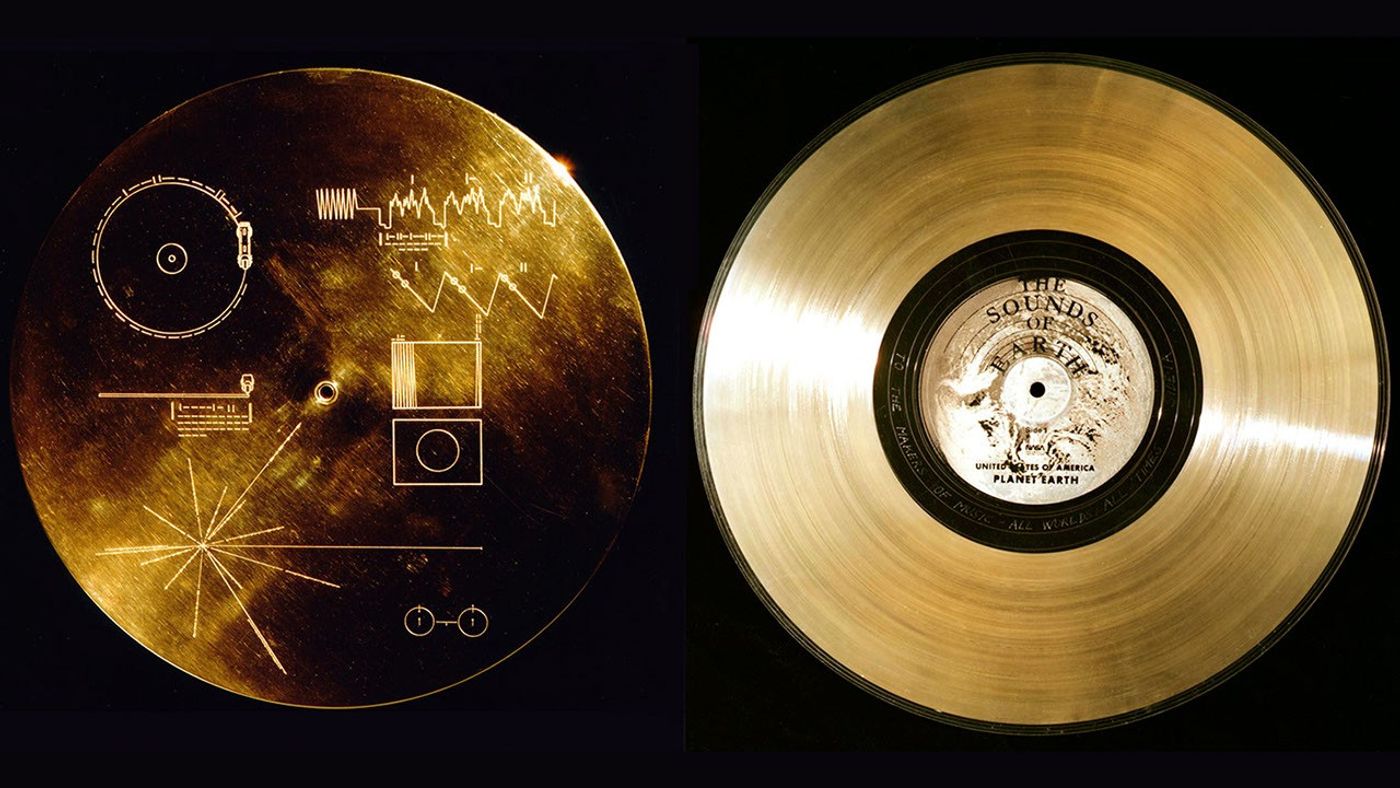
She leaned closer. Mounted to the body of the craft, protected by a simple bracket and cover plate, was a circular object. It was metallic, warm-toned, gleaming softly even in the harsh docking lights.
“Captain… what is this?” Talaan whispered.
“We didn’t touch it,” Jhesek said quickly.
Rhevek crossed his arms, studying the disk with narrowed eyes. “Decorative plating?”
“No,” Talaan said immediately. “It’s not decorative.”
The object’s surface bore precise etchings. Geometric patterns spiraling outward in a language she had never encountered. The patterns were too intentional to be ornamental. It was a deliberate code. A map of meaning. It spoke of communication, which showed intelligence.
Purpose.
Her pulse quickened.
She lifted a four-fingered hand toward the disk but stopped just short of contact, sensing that even a breath might disturb something ancient and fragile.
“It’s a message,” she murmured. “This entire craft… it’s a messenger.”
Rhevek stepped closer, tension coiled through his stance. “If it’s a message, who sent it?”
Talaan stared into the faint, warm shimmer reflected on the disk’s surface.
The etched lines seemed to catch the light in ways that felt purposeful, as if guiding her eyes to them.
“I don’t know,” she whispered.
“But someone wanted it to be found.”
The technicians had gone silent. Even the hum of cooling metal from the Veyasha felt muted, as if the bay itself held its breath.
Talaan pressed the release panel.
A thin seam split across the pod’s surface, followed by a gentle hiss of cold gas escaping the pressurized interior. The lid lifted with slow mechanical precision.
The bay’s lights caught the disk instantly. Radiance shimmered along its surface, as though sunlight had been trapped within it.
Talaan’s breath hitched.
Something stirred inside her. It felt like possibility. A pull, subtle but insistent, as if the object were whispering its importance.
“What are you?” she breathed.
Her voice was barely audible. But every scientist, every technician, even Captain Jhesek fell silent as if the question were meant for all of them.
Even Rhevek, tension coiled in his stance, leaned forward.
The golden disk did not answer.
But its very presence promised that something, or someone, might.
#
The decoding chamber was dim, steeped in a low hum of machinery and the soft, bioluminescent green cast of operational consoles. Glass surfaces reflected the glow in warped patches, as though the room were underwater.
Archivists, linguists, and auditory engineers crowded around the central projection array, their murmurs subdued in the air thick with anticipation.
Talaan stood at the primary console, fingers steady despite the tremor of excitement moving through her chest. The golden disk lay in its cradle nearby, rotating with a slow, ceremonial grace.
“Signal aligned,” she murmured. “Begin sequence.”
A low crackle split the silence. Then a voice spoke.
An alien voice.
Several of the archivists flinched. One reflexively clasped their hands over their auditory holes.
Another voice followed. And then another.
An unending tide of alien speech, each distinct, colliding and overlapping with fragments of meaning none of them could grasp.
Rhevek stiffened beside her. His hand moved instinctively toward the hilt of the short-blade at his hip, though he caught himself before touching it.
“What… language is that?” he asked, breath low but sharp.
Talaan shook her head slowly, entranced. “None that we know. And all of them seem different.”
Technicians exchanged anxious glances. Screens filled with chaotic waveforms. Lines of translation attempts crashed and reset.
Technicians exchanged uneasy looks. A linguist whispered, almost to themselves, “Why would a single species use so many forms of communication?”
Rhevek frowned deeply. “It’s illogical. Unity requires consistency. A unified species must share unified communication.”
“And yet…” Talaan said softly, “this species does not.”
Fluid, melodic intonations.
Harsh, clipped syllables.
Rolling cadences.
Sharp consonants.
Humorous lilts.
Somber tones.
None of it made sense to the Kethari.
But something did carry through the incomprehension.
Emotion.
There was a warmth beneath certain phrases. A rising urgency in others. A musical quality to languages that seemed almost sung.
Talaan leaned closer to the projection, drawn in like a tide tugged by a distant moon.
Linguists began isolating patterns, tracing phonemes, mapping intonations. Their glowing notepads filled with symbols and frantic conjectures.
Rhevek watched them with a blend of suspicion and thinly veiled awe.
It took weeks for the linguists to learn just one of the languages. Sleep-deprived linguists staggered in and out of the chamber. Patterns emerged slowly, painfully, like fossils being dusted free from stone.
Until finally, there was a breakthrough.
A single language revealed itself more frequently than the rest. Its phonetic structure, though alien, carried patterns the Kethari could decode more readily.
The linguists gathered around the console like pilgrims awaiting revelation.
“Play the first deciphered message,” Talaan said.
A deep alien voice came through, warm and composed.
They played it once. Then again. Then again, slower each time, transcribing every word.
“As the Secretary General of the United Nations…”
The chamber fell silent except for the voice reverberating through it.
Talaan’s throat tightened.
“…seeking only peace and friendship…”
Rhevek’s expression shifted, uncertainty flickering across his features before he masked it.
“…with humility and hope that we take this step.”
When the recording ended, it left a stillness so deep Talaan could hear her own pulse.
The Kethari stared at the projection in stunned silence.
Rhevek broke the silence first, voice low. “They address us directly.”
Talaan swallowed. “No… they address whoever might find them.”
“Which is us,” he replied quietly. And though his words were simple, something inside them felt heavier.
“They speak of peace and education,” Talaan said. Her voice carried something like wonder.
“It could be a lie,” Rhevek snapped urgently, as if pulling her back from a precipice.
“It doesn’t sound like a threat, Rhevek.”
Their eyes held each other, longer than appropriate for colleagues, longer than either quite understood.
“The Council must be notified,” a linguist said abruptly, breaking the moment.
Rhevek exhaled sharply and tore his gaze away. He nodded once, curt and controlled, then tapped his communicator as he turned toward the exit.
For a heartbeat, Talaan thought he might look back.
But he didn’t.
But she watched him go, a sense of motion inside her chest that wasn’t fear, wasn’t logic, wasn’t anything she’d ever been taught.
#
The chamber lights dimmed automatically as the data file engaged, casting everyone in a low blue haze. Archivists leaned forward. Scientists adjusted resonance filters. Rhevek moved unconsciously closer to Talaan, as though bracing for danger.
A single, breathless pause hung over the room.
Then, a roar, soft and rolling, surged from the speakers.
Every Kethari jerked in alarm.
The sound grew, swelling and collapsing in rhythmic pulses. It was wild, powerful, and impossibly large.
“What is that?” someone gasped.
The linguists scrambled across their consoles, but no translation appeared. This sound wasn’t language. It wasn’t mechanical. It didn’t fit any Kethari acoustic pattern.
And then another sound layered over the first.
A rhythmic crashing.
A hiss of swirling particles.
A thunderous break followed by gentle retreat.
Talaan leaned in, breath trembling.
“That almost sounds like our own ocean,” she murmured. It wasn’t exactly the same, but it was close enough for her to understand it. “Water moving. Striking against solid earth.”
The recording shifted.
Wind, soft at first, rushed through what must have been vast expanses of vegetation. The airflow trembled through leaves, creating overlapping harmonics no Kethari instrument had ever approximated. The room felt suddenly full of motion, of air, of life.
Then a low rumble sounded. The kind that seemed to vibrate inside the bones themselves.
It rolled with a scale and power that made even the soldiers in the room stiffen.
The Kethari had storms, but nothing like this. Their dying world no longer generated the deep, primal fury of a living planet.
Talaan whispered, “These… sounds are alive.”
Rhevek frowned, arms folding across his armored chest. “It’s chaotic. No rhythm. No purpose.”
She turned to him, eyebrows raised. “Does everything require purpose?”
“Yes.” His reply was immediate, instinctive. Then a small falter. “…Doesn’t it?”
But he kept listening.
More sounds followed. They were alien yet hauntingly familiar in some hidden part of Talaan’s mind.
A chorus of insects chirping into an endless night. Birds warbling, their calls rising and falling like organic instruments. A heartbeat-like thrum. Wind patterns shifting as though the planet itself were breathing.
As the forest chorus built, Rhevek’s posture eased. The rigid line of his shoulders softened. His hand dropped away from the blade he habitually touched when uneasy. His gaze unfocused, drawn forward in spite of himself.
He didn’t realize the tension leaving him. But Talaan did.
She watched the way the sounds worked on him. She could see how something softened behind his usual vigilance. How this chaotic, purposeless symphony of life bypassed his logic and reached something deeper.
Her chest warmed with an unfamiliar sensation, subtle at first, then insistently present.
Hope, yes. But also something else.
Something she had no name for.
Something she didn’t yet understand but felt whenever Rhevek let his guard slip like this, as though these sounds revealed the part of him that had never belonged to war or duty, the part shaped by their shared childhood, by memories before the sky dimmed and the core cooled.
The wind rustled again through the projection, gentle and sweeping.
Rhevek exhaled softly.
Talaan’s breath caught, not at the sound of Earth, but at the sight of him hearing it.
#
This time, the decoding chamber felt strangely intimate. No crowd of archivists. No bustling engineers. Only five.
Talaan, Rhevek, two neuroscientists, and a linguist.
The golden disk hovered in the projection cradle, its etched symbols glowing faintly as the console activated the next data file.
The air grew quiet with anticipation.
A series of luminous waveforms unfurled across the holographic display. They pulsed with a slow, rhythmic certainty, then spiked upward, then curved like flowing water.
One neuroscientist leaned forward, adjusting the resonance filters.
“These recordings,” she said softly, reverently, “appear to be neural signals. Not speech but a mind thinking, turned into sound.”
Talaan’s breath caught. “Whose mind?”
“We cannot know,” the scientist replied. “The probe does not identify them.”
Rhevek shifted behind Talaan, arms folded, posture stiff. “Why present thoughts? Why not words? Words have purpose.”
The neuroscientist gave a small, helpless laugh. “Perhaps they wanted us to know them beyond words.”
Rhevek did not look convinced.
The scientist entered a few commands. The playback began.
A faint hum played, which was steady and grounding.
Then a rise and a tremor of complexity.
Layers of thought blooming outward like petals unfurling in time-lapse.
The holographic waveforms shifted as if responding to the emotional weight of each idea.
“She’s thinking about her world,” the neuroscientist whispered. “About the history of Earth itself.”
Snapshots of meaning, sounds, flickered into the room through the neural resonance translation.
“You’re interpreting… this?” Rhevek asked skeptically.
“We’re interpreting patterns,” the scientist clarified. “Spike clusters associated with conceptual recall. She is remembering large-scale histories. Civilization. Evolution. Social structures.”
Talaan felt the magnitude of it wash over her.
The waveform dipped abruptly, then surged again. Sharply this time, violently.
The second neuroscientist inhaled sharply. “Violence. Poverty. The dangers her species faces. She’s contemplating… hardship.”
Rhevek leaned in, grim. “So Earthlings do experience conflict.”
“It would be illogical for a thriving species not to,” Talaan murmured, watching the waveforms stutter. “Survival demands it.”
Rhevek looked at her with a flicker of surprise, as if her pragmatism caught him off guard.
But then, the neural patterns shifted again.
This time they softened.
The room warmed with an emotional frequency none of them recognized.
“She is thinking of someone,” the neuroscientist said. Her voice had become barely a breath. “A specific someone.”
Talaan frowned. “Thinking how? With intent? Memory?”
“No.” The scientist lowered her voice further, as though speaking too loudly would shatter something fragile. “With attachment.”
Rhevek straightened. “Attachment to what?”
The neuroscientist hesitated, then gestured toward the curling, luminous waves. “To another individual. Notice the spike patterns? These are typical of emotional fixation. Her neural activity suggests… longing.”
Talaan felt something flutter in her stomach. “Longing for another? That’s inefficient.”
The neuroscientist offered a small, wry smile. “These Earthlings are very interesting creatures.”
Rhevek scoffed. “That is an absurd concept.”
But he didn’t sound entirely convinced.
The waveforms brightened, rising and falling like a heartbeat. The translation lattice struggled, then stabilized.
“They’re thinking about a state of profound emotional attachment,” the scientist explained.
Rhevek tensed. “I do not understand how they can survive as a species through emotional attachments.”
Talaan nodded reflexively, but her eyes drifted toward Rhevek without permission.
She studied the angled lines of his face, the disciplined set of his shoulders, the way he always positioned himself between her and the doorway.
Protective. Constant. Familiar.
She wondered… Did humans feel this warmth she felt now? This ache under the sternum? This strange awareness of another’s presence?
Rhevek turned his head and caught her staring.
“What?” he asked softly, the sharpness gone from his voice.
“Nothing,” she said too quickly.
The warmth blooming in her chest expanded, unbearable and undefined.
The waveforms pulsed gently, echoing the feeling neither of them had a word for.
In the shimmering glow, something hung between them that they could not possibly understand.
#
Talaan initiated the next file, and a single tone emerged, soft at first, then swelling into the air with startling clarity.
Every Kethari in the room flinched.
The sound was unlike language, unlike environmental noise, unlike anything produced by tools or natural forces. It carried structure and mathematical precision, yet wrapped itself in something far more elusive.
The second tone joined it. Then a third. Then an entire cascade.
Layer upon layer interlaced, each thread of sound weaving through another, rising and falling in patterns neither random nor utilitarian. There was intention here, yet not the kind that produced shelter or food or survival.
This was intention meant for feeling.
The Kethari froze in collective shock.
Then, slowly, as though guided by instinct they had never used before, they stilled.
They listened.
The sounds expanded, filling every shadowed corner of the chamber. Some notes swelled with longing, others pulsed with a quiet determination, others twined together in a way that made Talaan’s chest ache.
It felt like reaching upward.
It felt like reaching outward.
It felt like something inside her stretching toward a world that was not collapsing beneath her feet.
Her throat tightened. She didn’t know why.
She didn’t understand why anything the humans created struck so deeply.
Rhevek stood beside her like a statue. Rigid. Arms tense. Jaw set.
This was not battle or logic. Nothing he could combat or categorize.
The sounds pressed against him, slipping through the cracks of his armor, resonating in places he had not realized were hollow. His fingers twitched once, in an involuntary reaction.
He forced them still.
Another piece followed, darker and quieter than the first. A low, wavering hum.
A depth of emotion carried in vibrations so subtle he felt them more than heard them.
Slowly, almost imperceptibly, his posture loosened. His shoulders sank from their defensive angle. His breaths deepened. His bioluminescent markings glowed faintly in response to the sound, blooming along his throat in soft spirals. He didn’t notice. But Talaan did.
She reached out, her touch feather-light on his arm.
“Rhevek… you… like it.”
She said it softly, not to tease, but with a warmth she didn’t entirely understand.
“I do not,” he replied instantly.
But his voice lacked conviction. The sound still wrapped around him, making denial impossible.
“…Not entirely,” he added, quieter.
Talaan’s lips curved before she could stop them.
Rhevek looked away too fast, as if afraid she might see something exposed behind his usual discipline.
He didn’t realize she already had.
The music swelled again—achingly beautiful, and impossibly foreign.
Talaan let it wash over her, letting it paint color and feeling into the spaces grief had hollowed out. Something deep inside her stirred. Something fragile and bright, as if her mind were remembering an emotion her species had never possessed.
When she looked at Rhevek, she saw the same flicker in him.
#
When the next file began processing, the lab filled with quiet urgency. Archivists streamed back in. Scientists returned from their break cycles. Even officers lingered in the doorway. The air vibrated with the collective understanding that This was the first time they would see the species whose voices they had heard.
The projector sparked to life, flickering until it stabilized into a window onto another world.
The next image shifted into focus.
A larger human held a much smaller one against her body. Their faces were pressed together in a gesture the Kethari did not understand. It was equal parts protective, tender, and intimate.
Talaan touched her own chest without thinking.
They deciphered the next image before she had a chance to think about the implications of the human mother and child relationships.
A slender strip of land rose from a vast blue expanse. It was an island surrounded by water as far as sensors could perceive. The image conveyed both isolation and astonishing beauty.
Another image showed a twisting double-helix structure, which the Kethari deduced represented the blueprint of human life. Talaan recognized its purpose instantly: genetic code.
“Intricate,” one scientist murmured. “Perhaps more similar to ours than expected.”
The next image showed a view from far above the ground, showing swirls of white atmospheric vapor and the contours of continents. Earth’s surface glowed with vitality.
It showed humans lived on a living world.
A thriving world.
Whispers filled the chamber.
They looked at the next image.
Vehicles packed together along pathways, their movement structured yet chaotic. It was traffic, though the Kethari had no word for it. It was similar to the traffic of spaceships at docking bays.
Rhevek scowled. “Disorganized.”
“Complex,” Talaan corrected softly.
Next a woman stood in a brightly lit space filled with shelves and containers. She was putting some kind of food in her mouth, staring at the camera.
“A ritual of selection,” a linguist guessed.
“Resource gathering,” a scientist proposed.
Talaan smiled faintly. “Or simply choosing.”
The lab hummed with astonishment.
Some stood utterly still. Others leaned forward as if wanting to step into the images themselves. The room felt too small to hold the enormity of what they were witnessing.
#
Crowds flooded the plazas and concourses, gathering around projection pillars. Children reached toward images of endless blue water. Elders wept at the sight of forests that reminded them of Kethar’s lost equatorial jungles.
A new sound had returned to Kethar.
Laughter.
The golden stranger had brought it back.
In the streets, strangers leaned into each other with tentative conversation. In classrooms, children drew Earth’s creatures with glittering eyes. In temples long unused, priests whispered that perhaps this was the answer to prayers uttered in the dark.
The more the people watched, the more hope kindled. Fierce, hungry hope.
But in Rhevek’s private quarters, he stood surrounded by glowing maps, each pulsing red at fault lines and atmospheric breaches. The planet was tearing itself apart beneath his boots.
He shook his head.
Talaan entered without announcing herself. She had never needed to.
“I don’t like it, Talaan,” he said before turning. “This Earth. This message. This seduction.”
She tilted her head, arms folded. “Because it gives hope?”
“Because it hides,” he snapped. He stepped closer, the reflections of burning tectonic faults flickering in his eyes. “No mention of their wars. Their plagues. Their weapons.”
Talaan’s voice was steady. “And yet it still endures. Despite all those things. That’s more than Kethar can say.”
Rhevek looked away. “That’s not truth. That’s theatre. That’s propaganda dressed in song and pretty pictures.”
Talaan walked to the projection console, brushing her hand across its controls until the image shifted. Not Earth this time, but Kethar. The raw, ruptured land. The gray skies. A slow-motion collapse rendered in brutal fidelity.
She turned and sat across from him. “You fear what you don’t understand.”
“I fear extinction,” he corrected. “And I fear walking into the arms of a species that only shows its smiles. Why hide their dangers? Why hide their ugliness? Why hide their failures?”
“Because they want to be known at their best,” she said.
“But that’s manipulative,” Rhevek replied.
Talaan shook her head. “Don’t think we would do the same? If we were trying to reach out to an unknown universe? We’d want them to only see our successes.”
Silence coiled between them.
Talaan swallowed. “If we leave… will you come with me?”
He looked away. “Leaving our world feels like abandoning our ancestors.”
“Our ancestors are not breathing the air that we are,” she said softly. “And neither will our children.”
She let the word hang between them deliberately.
Children.
His head snapped up.
“You said you wouldn’t—”
“I still won’t,” she said gently. “Not here. Not on a dying world.”
He stared, stunned.
“But… perhaps on Earth,” she added quietly. “In a place where children laugh. Where they chase waves and plant things and speak in dozens of different languages just because they can.”
Something raw flickered across Rhevek’s face. Hope, fear, desire, confusion, Talaan couldn’t tell which emotion it was. Their species had no word for love, but something close to its distant echo trembled between them.
#
The sky above the capital dimmed as the fleet lifted into position. Mammoth arks shaped like crescent moons, silver wings arched outward, ready to drift. Evacuation lines snaked through what remained of the city, but there was no panic, no stampede.
Talaan stood at the bridge of the command vessel, the golden disk secured in a containment cradle beside her. Rhevek stood near her right shoulder, armored and alert, though no longer quite braced for war.
The engines hummed, a rising harmony that matched the thrum in her chest.
He leaned toward her.
“You’re certain of this?” he asked.
Talaan didn’t answer at first. She watched through the viewport as their fractured planet receded in the glass, shrinking and flickering beneath atmospheric haze.
“No,” she said at last. “But certainty was never promised.”
“To the Earthlings, we will seem alien. Colorful, eyes like carved gemstones, four-pronged appendages.”
“They will accept us. We’ve seen how they are. They are a curious, welcoming species.”
The comms technician turned toward her, waiting for the signal. Talaan stepped forward.
She pressed her palm to the console, eyes fixed on the space beyond.
The engines thrummed as the fleet powered up.
Across the bridge, technicians prepared a communication burst toward Earth. It was a greeting spoken in the language the Kethari had managed to translate.
Talaan spoke the message aloud before they transmitted it, feeling its weight and its promise.
“We have discovered you. We are coming.”
 Gabby Gaspard